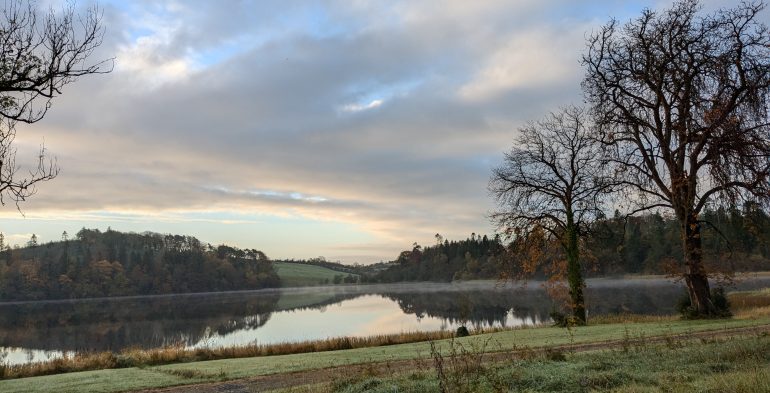
In October, Aimee Wall boarded a plane to spend three weeks at the Tyrone Guthrie Centre in Annaghmakerrig, Ireland, as the 2024 Max Margles Writer in Residence. Here is the second and last of her dispatches. Read Part One.
I very quickly realize, upon arriving at the Tyrone Guthrie Centre, that this is not the type of residency where I’m going to hole up in my room working and shut out the outside world for days on end. There is a time and a place for that kind of residency or retreat, self-made or otherwise, but what is on offer at Annaghmakerrig is something else—time to work and think, yes, but also an opportunity for something more, a brief but intense time of community, a chance to spend time with and learn from the other artists and writers and musicians sharing the big beautiful house with me.
I decide early on that this is just as important to me as the new pages I’m hoping to write, that I will do my work but also stay open to all the other parts of this experience, take in as much as I can.
One of the things I was most looking forward to in spending some time in Ireland was the language. I was curious about the Irish language, about its place in daily life and in the culture, how people use it now, where it’s spoken, by whom, and how people feel about it.
I had many questions. But I often didn’t even need to ask them outright, I just had to listen to the winding, lively conversations at the dinner table between the other residents, most of them Irish, from all over Ireland, and so with different accents in English, different relations to the Irish language. I am happy to find that the others are just as interested in talking about all this as I am.
One night at dinner, someone says how Hiberno-English is “English woven on a Gaelic loom.” They’re quoting a journalist named Con Houlihan, though in the moment I’m so struck by this beautiful image that I promptly forget his name and have to look it up later in my room. I will do a lot of looking things up later in my room.
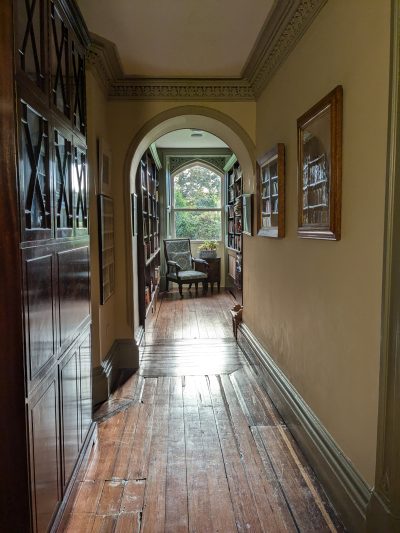
I grew up in Newfoundland, where our English is still tinged by Irish, inflected by Hiberno-English. The “after perfect” lifted directly from Irish, as in, “she’s after having her dinner.” The accents, the rhythm, the way we hit certain vowels. Sometimes I’d meet someone at the residency and feel instantly warm toward them because their accent sounded so familiar to me.
Now I’ve lived over a decade in Montreal, where my English has shifted a little, been imprinted by the French I also speak every day, and I make a living as a translator, constantly straddling two linguistic worlds. I’m always interested in the way languages coexist in people’s lives and in their work, and I’m particularly drawn to the hyper local, to dialects and regionalisms, and to minority languages, the commitment to keep them living and alive.
One of the first people I meet at Annaghmakerrig is a native Irish speaker, working on a book in Irish. For others, Irish is a language learned at school, and so they might have a more formal relation to it, but it’s still part of the fabric of their lives. Another resident came to Ireland as an adult from another country, but lives in a Gaeltacht, a district recognized by the Irish government as a place where Irish is the predominant language, and so her children go to school in Irish.
It becomes very clear very fast that in three weeks I will barely begin to scratch the surface of learning or understanding anything about this language and its history and the ways it exists and is spoken today. This just ignites a deeper, more urgent curiosity.
I borrow a couple of books from another resident—a green grammar book that reminds me of the Bescherelle of my high school French classes, a book of legends in both English and Irish—knowing I won’t have time here to do much more than look at the beautiful words and try to begin to understand something about their structure, their sounds.
I download Duolingo and start doing Irish lessons on my phone.
By the time my three weeks are up, I’ve gotten a lot of work done. I’m leaving with the draft I’d hoped to finish, but I’m also leaving with something bigger but less tangible, this feeling like I don’t know yet what I’ll make of this whole experience, all these conversations and connections, all these new ideas, but that it will be something.
In the taxi on my way to the bus station in Monaghan, the day I leave Annaghmakerrig, I sit in the front and chat with the driver and he tells me about the place names in Ireland, how many of the English names still bear traces of the original Irish names that described the landscape. I say I’m a little sad to be leaving and he tells me that, in Irish, to say “I’m sad,” you would say, literally, “sadness is upon me.” He makes a gentle gesture over his face with his hand as he says this, his eyes still on the winding road.
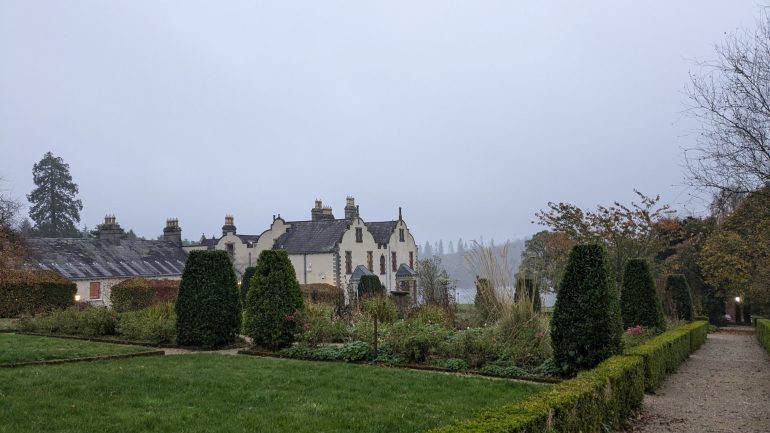
As I write this, I’ve been back at my own desk in Montreal for some weeks now, and Annaghmakerrig seems almost like a dream. But I still feel energized from such an intense little period of time spent with other artists; I’m still thinking about all the things I learned. A week after I get home, I’m struck with an idea for a new project that I can trace, in a winding, circuitous way, directly back to the kitchen table.
I’m so grateful I had this opportunity. Thank you to Mrs. Roslyn Margles and to the Quebec Writers’ Federation for making it possible.
This blog post is part of QWF’s Dispatches from Ireland series written by the annual Max Margles Writer in Residence.