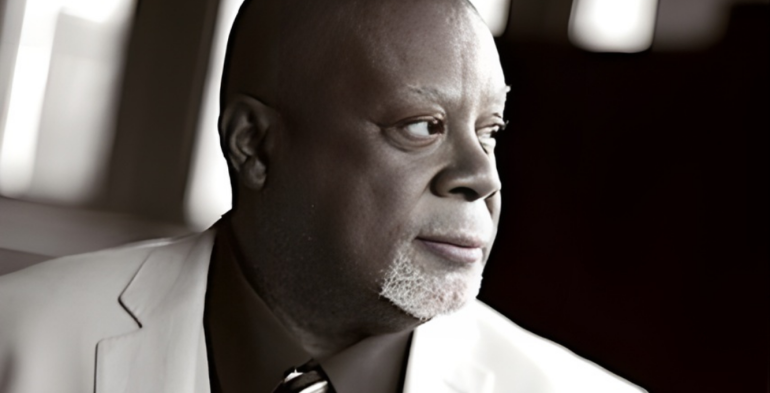
Fred Anderson is a writer, an activist, a finalist for the 2025 QWF Literary Awards, and QWF’s latest featured member.
Born in Hattiesburg, Mississippi, Fred Anderson joined the Civil Rights Movement as a teenager and became field secretary of the Student Non-Violent Coordinating Committee. After fleeing to Montreal as a Vietnam war resister in 1966, he lived under an assumed name for 11 years. Awarded the 1973 Board of Governors Medal for Creative Expression in Literary Arts at Sir George Williams University, he was instrumental in co-founding a Black literary forum and two Black research institutes. He worked for many years in rehabilitation centres for teenage girls, including in Northern Quebec with Cree and Inuit youth. His memoir, Eyes Have Seen: From Mississippi to Montreal, was published earlier this year and is a finalist the 2025 Concordia University First Book Prize.
QWF Communications Officer John Wickham spoke to Fred about his memoir, his motivations for writing it, and his life as an activist on both sides of the border. Here are five questions for Fred Anderson:
1) Congratulations on being a finalist for this year’s QWF Literary Awards! Can you tell us a bit about the book?
Beneath the surface of every name lies a story, and beneath every story, a longing to return home. Eyes Have Seen traces my journey through the tangled branches of my family tree, social activism, where memory and myth intertwine. Each chapter is a reclamation—of voices once hushed, of places left behind, of selves scattered across time. From whispered quilting bee tales to the unspoken ache of distance. Eyes Have Seen is a meditation on where we come from and what we carry forward. It is both a love letter to ancestry and an elegy for belonging—a reminder that sometimes, finding ourselves means listening to the echoes that call us back.
2) In the book’s introduction, you say you “have attempted many beginnings at this memoir.” Why write this book and put it out into the world now?
Now feels like the right time because the questions that shaped our generation—about justice, belonging, and the courage to stand firm—are being asked again. The past is not the past, it lives inside us, waiting to be heard. Writing this book is my way of answering back—with memory, with truth, and with love for those who made the world shift, even if history forgot to write down their names. I remember the long nights, the whispered plans, the songs that steadied us when the world seemed to tremble. I remember the faces—weary, determined, alive with purpose. Those memories still live in me, and I owe them this telling.
3) You were a teenager when you became field secretary for the Student Nonviolent Coordinating Committee (SNCC). How did you come to join it?
Back then, it wasn’t history yet—it was urgency. The air in those days was charged, restless, alive with questions we couldn’t stop asking: How long? Why not now? SNCC found me the way a river finds the sea—through a series of small quiet tributaries of conscience. Someone passed along a leaflet after church. Someone else mentioned a meeting on the school campus, just across town. I remember the room: folding chairs, handwritten signs, the smell of coffee and nervous courage. I didn’t yet know the language of politics, but I felt the need to be involved. I didn’t know then that SNCC would become my compass—that its lessons in courage, discipline, and community would guide me across borders, into exile, and into the long work of rebuilding a life in another country. But in that first meeting, I felt it: the quiet certainty that my life had turned a corner.
4) You began at the SNCC in Mississippi, but your work as an activist persisted well after you left the United States and came to Montreal. How did those early experiences inform your later work as an activist and community organizer here in Montreal?
In Montreal’s Black community, I found echoes of the same struggles and the same resilience—people building institutions, reclaiming identity, and creating spaces of possibility in the face of exclusion. My civil rights experiences helped me see that the work of liberation is never bound by geography. It’s a way of living, a discipline of hope. Whether on the streets of the American South or in the neighborhoods of Montreal, the heart of the struggle is the same: to make a place where our stories matter, our children thrive, and our humanity is not negotiable.
5) What was the most difficult part of this book to write?
Writing about the death of my grandmother, storyteller and the narrative voice of Eyes Have Seen. This was the chapter that refused to come quietly. Each word trembled beneath the weight of memory, as if the past itself resisted being translated into language. I wrote and rewrote until the silence began to speak. It felt like trying to hold smoke. Every time I reached for the memory, it changed shape—part ache, part silence, part love. I didn’t know how to write her without breaking her open again, or myself along with her. Grief made everything smaller at first—the world, my voice, even my name. But as I wrote, I began to see her in the spaces between the sentences, in the rhythm of what I couldn’t say. She was in the way I hesitated, in the way I kept going anyway. Losing her didn’t take me away from who I was; it brought me closer to where I began.
Thank you, Fred!
Eyes Have Seen: From Mississippi to Montreal is available online and at local bookstores.
On November 13th, Fred Anderson will hold a talk and book signing at Paragraphe Books in partnership with the McGill Institute for the Study of Canada. Learn more and RSVP on Facebook.
The winner of the 2025 Concordia University First Book Prize—along with the winners of the other 2025 QWF Literary Awards—will be announced at the QWF Gala on the evening of Monday, November 10.