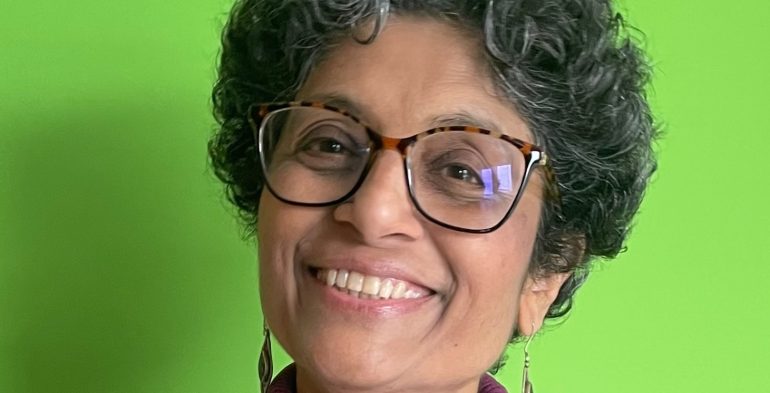
Writer Veena Gokhale is QWF’s latest featured member.
An immigrant shape-shifter, Veena started her career as a print journalist in Bombay. This tough, tantalizing city inspired her book Bombay Wali and Other Stories (Guernica Editions, 2013).
Veena first came to Canada on a journalism fellowship and returned to do a master’s. She then started working for Canadian non-profit organizations. Her novel Land for Fatimah (Guernica, 2018) is partly inspired by a two-year working stint with a Tanzanian international development organization.
After following her French-Canadian partner to Montréal, Veena started learning French and giving Indian vegetarian cooking classes in French and English. She sought food-related Indian legends and did some storytelling around them at multicultural events. This led to her latest book, Annapurna’s Bounty: Indian Food Legends Retold (Dundurn Press).
The book is included on several recommended reading lists, including CBC’s 14 Canadian short story collections to read for Short Story Month and the Giller Prize’s Honouring Influential Fiction by Asian Canadian Writers for Asian Heritage Month.
Veena teaches English as a second language. Her fiction and non-fiction, including book reviews, have appeared in Canadian literary magazines and anthologies. She also curates an annual event for the Kabir Cultural Centre in Montréal called the Garden of Literary Delights, which spotlights the work of Canadian writers of South Asian origin across several genres.
Having lived in ten cities in three countries, she now calls Tiohtià:ke/Montréal home.
QWF Communications Officer John Wickham spoke to Veena about her latest book, Annapurna’s Bounty, and what’s on the horizon for her. Here are Five Questions for Veena Gokhale:
1) Congratulations on the new book! Can you tell us a bit about it?
Thank you. Annapurna’s Bounty, Indian Food Legends Retold recasts Indian myths, legends, folktales, and historical narratives related to food into literary short stories that would appeal to the contemporary reader. Here, food manifests as a ploy, a bargain, symbolic communication, a bone of contention, a lesson, etc. The cast of characters is varied, and each story is followed by a vegetarian recipe. The recipes come from all over India, as do the original stories. The last story is entirely made up and is inspired by the beloved samosa.
2) What led you to write a book centred around food?
In 2015, for a number of reasons, I started giving Indian vegetarian cooking classes. My lifelong passion for writing and reading led me to food legends, and I encountered Annapurna, the Indian Goddess of Nourishment. I started doing presentations about Indian spices and food, always retelling a food legend as well, at multicultural events in Quebec.
I applied to the Conseil des arts et des lettres du Québec for a grant. It came through in March 2020. That manuscript eventually became Annapurna’s Bounty, thanks to Dundurn Press. Adding recipes made sense, and I had introduced that notion in the grant application as well.
3) In a 2017 article for QWF Writes, you discuss using non-English words in your writing and how it pertains to Salman Rushdie’s idea of “decoloniz[ing] the English language.” In what ways does Annapurna’s Bounty continue this decolonizing practice?
I certainly stand by that idea! I went to what we call an English-medium school in India, and English became my best language by far, though I love some Indian languages more. Like Rushdie, I believe in pluralism, including stylistic diversity, and freedom of expression. Rushdie experimented with English itself, and in any case there are many “Englishes.” I use words and phrases from Hindi and Marathi, and also Farsi and Arabic, in Annapurna’s Bounty. Marathi is my mother tongue. I kindly translate them into English, most of the time, though no translation, linguistic or cultural, was provided to countless readers as they adventurously ploughed through Western texts in English! As to whether this book represents a decolonizing practice, I leave that for the academics to figure out. : )
4) I have to ask…do you have a favourite recipe from the book?
That’s a tough one, but I’ll settle for khichari, a rice and lentil dish found all over India, though sometimes under different names. It can be simple or elaborate. For the book, I chose the version from Bengal, which my mother introduced to our family at some point. A flavourful, balanced, one-dish meal, it contains several spices and veggies. Best served with a couple of sides. Enjoy!
5) What’s next for you?
There’s a manuscript entitled The Artichoke, Sensuous Stories, which is about sex, desire, longing, fantasy, and the senses—smell, taste, sight, etc. It’s been in the making for years. I’m thinking of accompanying the stories with rituals and recipes, as well as images and pieces of music in the public domain, posted online, which readers would reach via QR codes.
I have also researched and outlined a novel that has at its heart Buddhism. I took refuge, as they say, in that religion in 2002. With Annapurna’s Bounty, I stepped into magic realism, which is great fun, and to be continued. The central character is a Boddhisatva. You’ll have to look that up, as I’ve run out of space!
Thank you, Veena!
Annapurna’s Bounty, Indian Food Legends Retold is available now in bookstores and online, including on the publisher’s website. For more about Veena, visit her website.